Our Research
An economically sustainable programme for real-time tracking and predicting resilience, resistance, and burnout among frontline social care and community organisation workers
What will we do?
We will carry out a scoping review of existing research on resilience, resistance, and burnout among social workers, social care workers, and community and voluntary organisation staff. This will include studies that explore the economic impacts of these issues on workers, services, and the people they support, as well as research on the use of visual dashboards in social care and related settings.
We will work with professional practice social media groups to help develop visual dashboards that show real-time and emerging trends in resilience, resistance, and burnout. Using a secure system, anonymised posts from participating groups will be analysed to produce simple, easy-to-understand graphs. We will also develop a visual economic analysis to show how these trends may affect frontline workers, services, and service users. Together, these outputs will support a clearer, shared understanding of workforce wellbeing across Greater London and the East of England.
To help interpret these findings, we will invite social workers, social care staff, and community and voluntary organisation workers to complete an anonymous online survey. Participants will be asked for their views on the trends identified, possible reasons for changes over time, and how clear and useful they find the visual outputs.
We will also invite frontline workers to take part in focus groups, and managers to take part in interviews, all led by our PPIE Co‑Leads. These discussions will explore survey findings in more depth, including possible triggers for changes in resilience, resistance, and burnout, the economic implications for workers and services, and the usability of the dashboard. All forms of participation will help ensure that the findings reflect real frontline experiences.
How are we working with communities, services and organisations?
Our project is co-produced with people who have lived experience. The team includes PPIE Co‑Leads who are social workers and who experienced frontline service delivery during COVID‑19. They are involved in co-designing, developing, and delivering every stage of the project.
Our PPIE Co‑Leads, alongside a former healthcare worker now working as a researcher, are actively building relationships with networks of social workers, social care staff, and community and voluntary organisation workers across both regions, including peer support workers. This includes collaboration with the Digital and Community Engagement Co‑ordinator for community organisations in Cambridgeshire and Peterborough.
Ahead of the project, we also recruited five public contributors with diverse backgrounds and experiences, including older adults, people from minority ethnic backgrounds, and people with experience of poor mental and physical health. We are holding staged consultations with this group throughout the project to ensure our work remains grounded in lived experience.
Our Advisory Board includes NHS staff, a clinician from the UK Health Security Agency, and experts in cultural geography, digital analytics, workforce health, and marketing from universities in the UK, USA, and Australia. We are working in partnership with ARC East of England and ARC North Thames, and the project is listed on the RDN portfolio.
What do we have planned for knowledge mobilisation and implementation?
We will co-develop practice-focused recommendations based on the study findings and deliver knowledge exchange workshops to introduce the tracking and predictive system, supported by real-world case study examples.
We will also co-create plain-language implementation guidance and dissemination materials with public partners, ensuring accessibility, cultural responsiveness, and relevance to different audiences. Outputs will include visual summaries, community briefings, short videos, plain English booklets with artwork, training materials, and dissemination through trusted local partners to support meaningful and lasting impact.
What will the impacts and benefits of this research be?
Impact:
Clear, visual evidence to support decisions about investing in measures that strengthen resilience and resistance and reduce burnout among frontline social care and community organisation workers.
Benefits:
Over time, more responsive and targeted support informed by real-time and predictive trends is expected to contribute to lower burnout, stronger resilience, improved job satisfaction, and better staff retention, with wider benefits for services and the people they support.
Related papers, outputs and resources
We will publish several academic papers in public health, social care, and frontline services journals, beginning with a scoping review.
Findings will be shared with social care, public health, and long‑term care audiences through national and international dissemination activities, including conference presentations and papers, workshops, and practice‑focused events, as well as through relevant research and service networks.
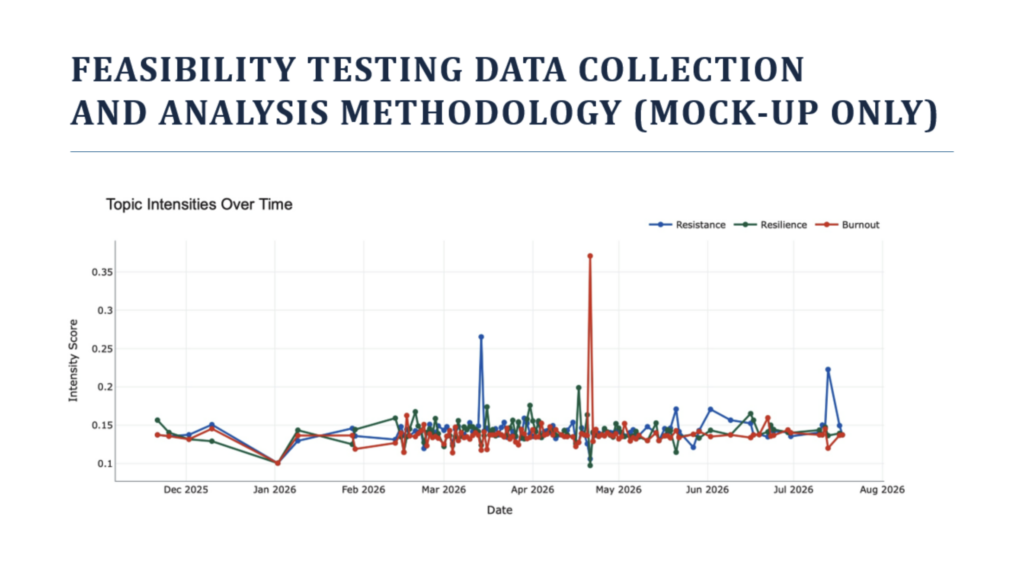
Outputs will include an example visual dashboard (see example above) showing real-time and predictive trends in resilience, resistance, and burnout, alongside an integrated visualisation of economic impacts, co-designed with community, service, and organisational partners.
A required output of this Programme Development Grant is a Programme Grant for Applied Research (PGfAR) application, which will extend the work to include NHS staff alongside social care and community organisation workers. This application has been identified as a priority for institutional support by the University of Cambridge.
Further materials will be shared through our knowledge mobilisation and implementation activities, including visual summaries, community briefings, videos, plain English booklets, and training resources.